Home batteries in Marbella: your own solar after dark, and power when the grid goes down

A battery stores what the roof makes at midday for the evening, when a household here uses most and the panels make nothing.

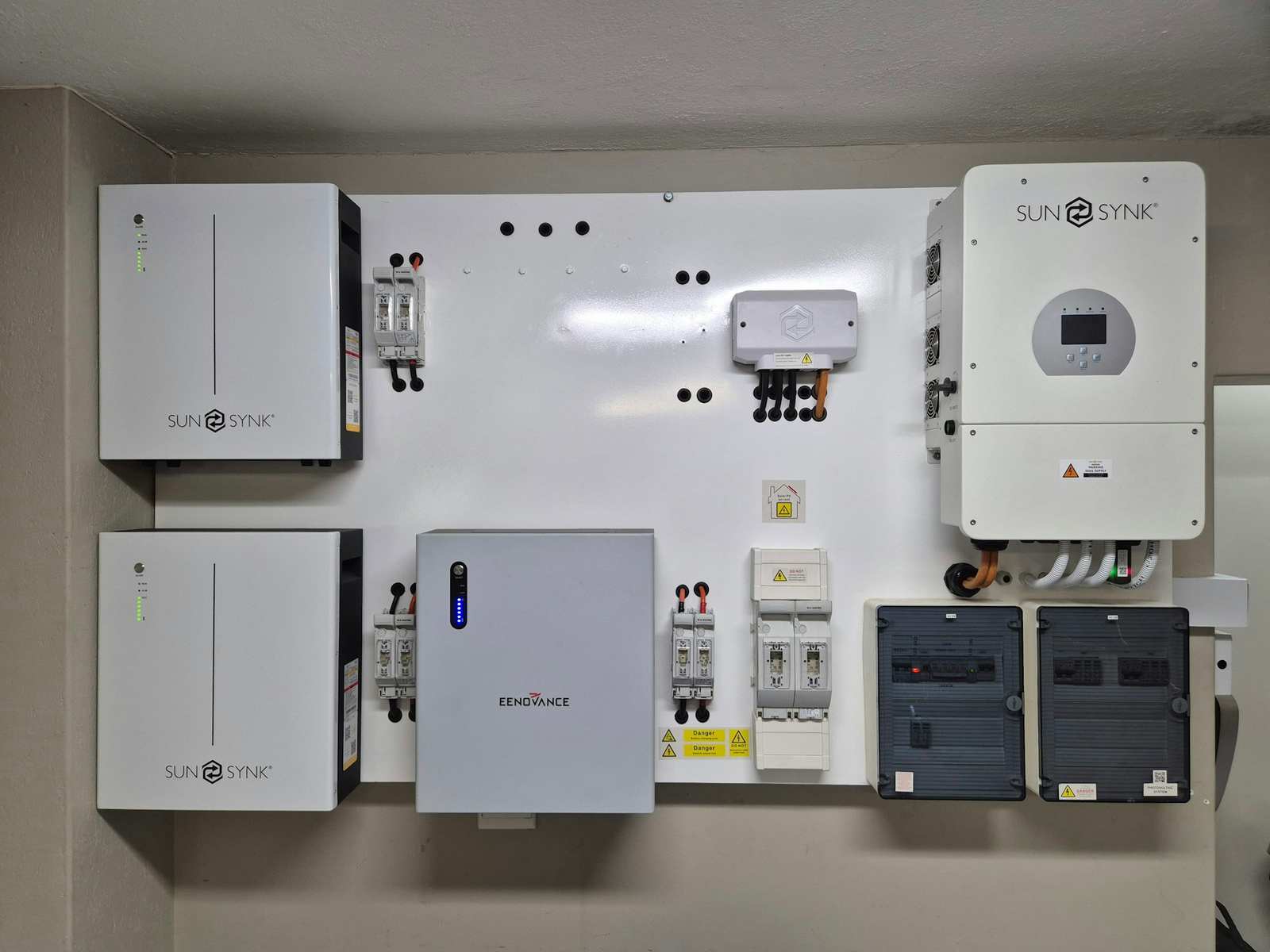
Two wall-mounted home batteries beside a hybrid solar inverter and its protection boxes

What a battery changes

Panels alone cover the electricity you use while the sun is up. For most homes that is between a third and a half of the total; the rest of what the roof makes is exported for a few cents a unit, and bought back at night for several times that.

A battery moves the midday surplus to the evening. Take a villa paying €220 a month. With panels alone, about 33% of its electricity comes from its own roof. With a 10 kWh battery and a couple more panels, that rises to about 78%, and the yearly saving goes from about €890 to about €1,590.

We will be straight about the economics. The battery costs more than the extra saving repays in its first years, so on money alone it pays back more slowly than the panels. People choose one for three reasons that are not on the bill: independence from price rises, backup in a power cut, and the satisfaction of running on their own sun at midnight.

Where a villa’s electricity comes from

Panels only

33% from the roof

Panels and a 10 kWh battery

78% from the roof

A home paying €220 a month, using electricity through the day. Worked out with the calculator’s assumptions.

Backup: what happens when the grid fails

On 28 April 2025 the whole Iberian peninsula lost power for most of a day, and thousands of homes with solar panels on the roof sat in the dark with everyone else. A standard inverter must switch off when the grid does. It is a safety rule, and it surprises almost everyone.

A battery system with a backup function works differently. When the grid drops, a switch isolates the house from the street within a moment, and the inverter carries on from the battery and the panels. When the grid returns it reconnects by itself.

You choose how much of the house it covers:

  • Essential circuits. Fridge and freezer, lighting, internet, a few sockets, the gate and the alarm. The usual choice, and enough to ride out a long cut in comfort.
  • The whole house. Needs a larger inverter and battery, and some care with heavy loads such as ovens, air conditioning and car chargers.

Not every battery inverter has backup, and it has to be wired in at installation. If it matters to you, say so at the survey.

A hand holding a tablet showing system data in front of an electrical panel

Sizes and guide prices

Fitted, with IVA, alongside new panels. Adding one to an existing system can cost a little more.

Usable capacity Suits A typical night Guide price
5 kWh Apartments and townhouses using up to about 5,000 kWh a year Lighting, fridge, television, internet and cooking for a small household €3,000 to €4,000
10 kWh Family homes and villas using 5,000 to 12,000 kWh a year The above for a larger household, plus a few hours of air conditioning €4,500 to €6,500
15 kWh and up Large villas, whole-house backup, homes with a weak grid connection Most of the house through to morning Quoted per project
Most home batteries are modular: capacity can be added later in blocks, as long as the inverter is sized for it.

Adding a battery to panels you already have

If your inverter is a hybrid, a compatible battery connects straight to it and the job takes an afternoon. If it is not, there are two routes: swap the inverter for a hybrid, or add a battery with its own inverter beside the one you have. Which is cheaper depends on the age and make of your system. Send us a photo of the inverter’s label and we will tell you.

Physical battery or virtual battery?

Several electricity companies now sell a “virtual battery”: instead of losing surplus credit you could not use this month, it is kept in an account and taken off later bills. It costs little or nothing and suits homes that are empty part of the year.

It is an accounting arrangement, though. You still export at a low price and import at a high one, and it does nothing in a power cut. The two work well together.

Where it goes, and how long it lasts

In a garage, utility room or plant room: somewhere dry, shaded and ventilated, close to the consumer unit. Batteries dislike heat, so not on a south-facing outside wall. Modern home batteries use lithium iron phosphate cells and are guaranteed for ten years by their makers.

Questions about batteries

All questions and answers

Is a battery worth it?

It depends what you want from it. On savings alone, a battery typically raises the share of your electricity that comes from your own roof from 30–45% to 70–80%, but it takes longer to pay back than the panels do. If you want backup in a power cut, or you are away all day and home all evening, or your supplier pays little for surplus, it earns its place.

A reasonable middle course is to fit a hybrid inverter now and leave space for the battery, which can then be added in an afternoon. More on our battery page.

Will my panels keep the house running in a power cut?

Not on their own. A standard solar inverter is required to shut down when the grid fails, so that it cannot feed electricity into lines people may be working on. Many owners found this out during the Iberian blackout of 28 April 2025.

To keep running you need a battery and an inverter with a backup function, wired so that the house, or the circuits you choose, is isolated from the grid when it goes down. It is worth deciding at the design stage; adding it later costs more.

Can you add a battery to panels I already have?

Usually, yes. If the existing inverter is a hybrid, a compatible battery connects straight to it. If not, we either replace the inverter with a hybrid or add a battery with its own inverter alongside (an AC-coupled battery), whichever costs less for your system. Send us the make and model of the inverter, or a photo of its label, and we can tell you which.

Are there grants or tax deductions?

The Next Generation grants many people remember closed to applications at the end of 2023. At the time of writing (November 2026) two things are available:

  • Income tax (IRPF). Spanish tax residents can deduct part of the cost of a self-consumption system installed and paid for in 2026, and there is a larger deduction for work that cuts a main home’s energy use by at least 30%, proved with energy certificates before and after. Nothing has been confirmed for 2027.
  • Junta de Andalucía. The Andalusian Energy Agency opened a new incentive line in October 2026 for homes, which for solar requires a battery. Funds are limited and the conditions are strict.

We tell you plainly which of these your project can use and prepare the technical documents. For the tax return itself, speak to your gestor.

What happens to the electricity I do not use?

It goes into the grid and your electricity company credits it against your bill. This is called simplified surplus compensation. Fixed tariffs pay between about 3.5 and 7 cents per kWh, most often around 6; on the regulated tariff you get the hourly market price.

The credit can reduce the energy part of the bill to zero but not below, which is why oversizing a system does not pay. Several suppliers now offer a “virtual battery” that carries unused credit forward to later months. Compensation typically starts one to three months after the system is registered.

Thinking about a battery?

Tell us what you have now and what you want it to do in a power cut. We will size it properly and tell you honestly whether it is worth it.

Get a free quote